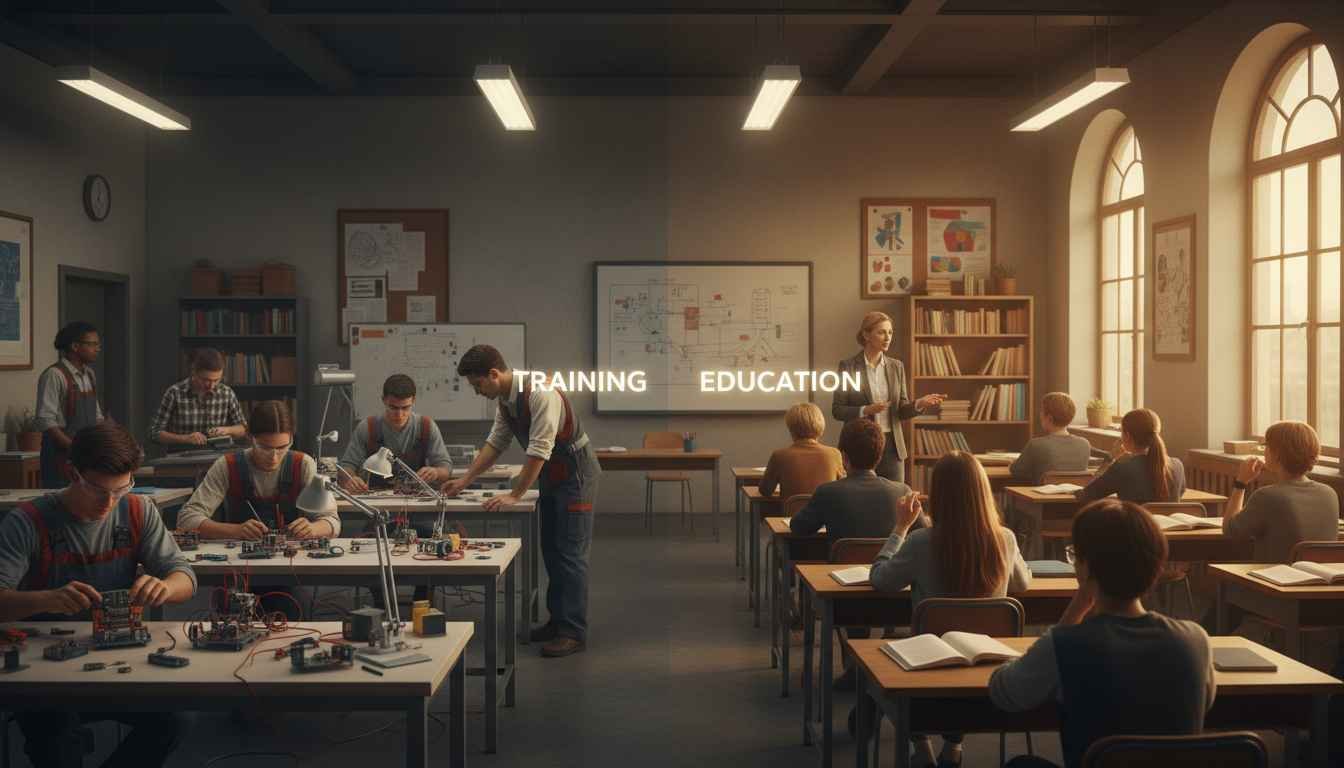
Here lies a paradox: one can be trained without understanding, and educated without doing. It is a subtle tension, a dance between the hands and the mind, the body and the soul. Training often molds the immediate; education shapes the enduring. Yet in the modern world, the lines blur, leaving many to wonder: where does one end, and the other begin?
Training begins with a task. It is precise, directive, and tangible. Consider learning to meditate in a silent hall. A trainer might guide your posture, breathing, and focus, correcting every tilt of the head or wandering of the mind. Here, repetition is the rhythm, efficiency the goal. You gain skill, often measurable, observable, and immediate. It is the sharpening of a single blade, the honing of one capacity.
Education, in contrast, is the opening of horizons. It is not just the posture or the breath but the inquiry: why do we breathe this way? How does focus alter perception? Education invites reflection, discussion, and the integration of knowledge into life’s broader tapestry. It encourages curiosity and critical thinking, stretching the mind to consider the invisible connections between thought, action, and consequence. While training asks, “Can you do it?” education asks, “Do you understand it?”
Naropa University embodies this harmony, blending hands-on learning with contemplative insight. Here, the goal is not merely proficiency but wisdom – the ability to act with awareness in the world.
Before and After: A Minimalist Experiment
To illustrate, I conducted a simple test in two parts. First, I underwent a week-long calligraphy workshop – a pure training exercise. Each stroke was corrected, each angle perfected. My hand grew steady, my letters uniform. But my mind wandered, questioning the origin of each symbol, the philosophy behind the brush.
Then, I engaged in a parallel course in the history and philosophy of script. Here, no stroke was corrected; no angle enforced. Instead, I explored the culture, the thought patterns, the aesthetic philosophy. By the end, my letters were less perfect but carried a sense of intentionality and depth. Training had given skill; education had given context and meaning.
Before and After List
Before Training: Clumsy hands, uncertain motions, fleeting confidence.
As we navigate the intricate landscape of learning, the distinction between training and education becomes increasingly relevant, especially in the context of modern technological advancements. The rise of online platforms and digital tools has revolutionized how knowledge is disseminated and consumed, blending these two concepts in unprecedented ways. This transformation is further amplified by the strategic implementation of Digital marketing in education, which not only enhances accessibility but also fosters engagement and personalization in learning experiences. Consequently, educational institutions must adapt to this paradigm shift, leveraging digital strategies to ensure that their offerings resonate with a diverse and global audience, thereby bridging the gap between immediate skills acquisition and long-term intellectual growth.
After Training: Controlled movements, immediate skill, measurable improvement.
Before Education: Curiosity simmering, scattered questions, vague awareness.
After Education: Contextual understanding, deeper insight, reflective capability.
Potential Drawbacks
While the synergy of training and education is ideal, imbalance can lead to pitfalls. Too much training without reflection may produce efficiency without understanding – competent yet blind. Excessive education without practical application may foster knowledge without action – a scholar untested in the real world. Recognizing this, one must seek the balance appropriate to their goals, tempering immediate skill with thoughtful comprehension.
Who Should Avoid This?
Those who value speed over depth, or tangible results above insight, may find the merging of training and education frustrating. If a task requires only repetition, immersion in theory may feel burdensome. Conversely, if life demands critical thinking, prioritizing rote skill alone may leave one unprepared for complex challenges. Knowing which approach to lean on is as important as the approach itself.
Quote of the Day
“Education is not the filling of a pail, but the lighting of a fire.” – William Butler Yeats
In the end, the difference between training and education is both subtle and profound. One crafts ability; the other nurtures wisdom. One shapes the hands; the other expands the mind. Recognizing the boundary, and sometimes stepping beyond it, is the journey toward mastery, awareness, and mindful living.