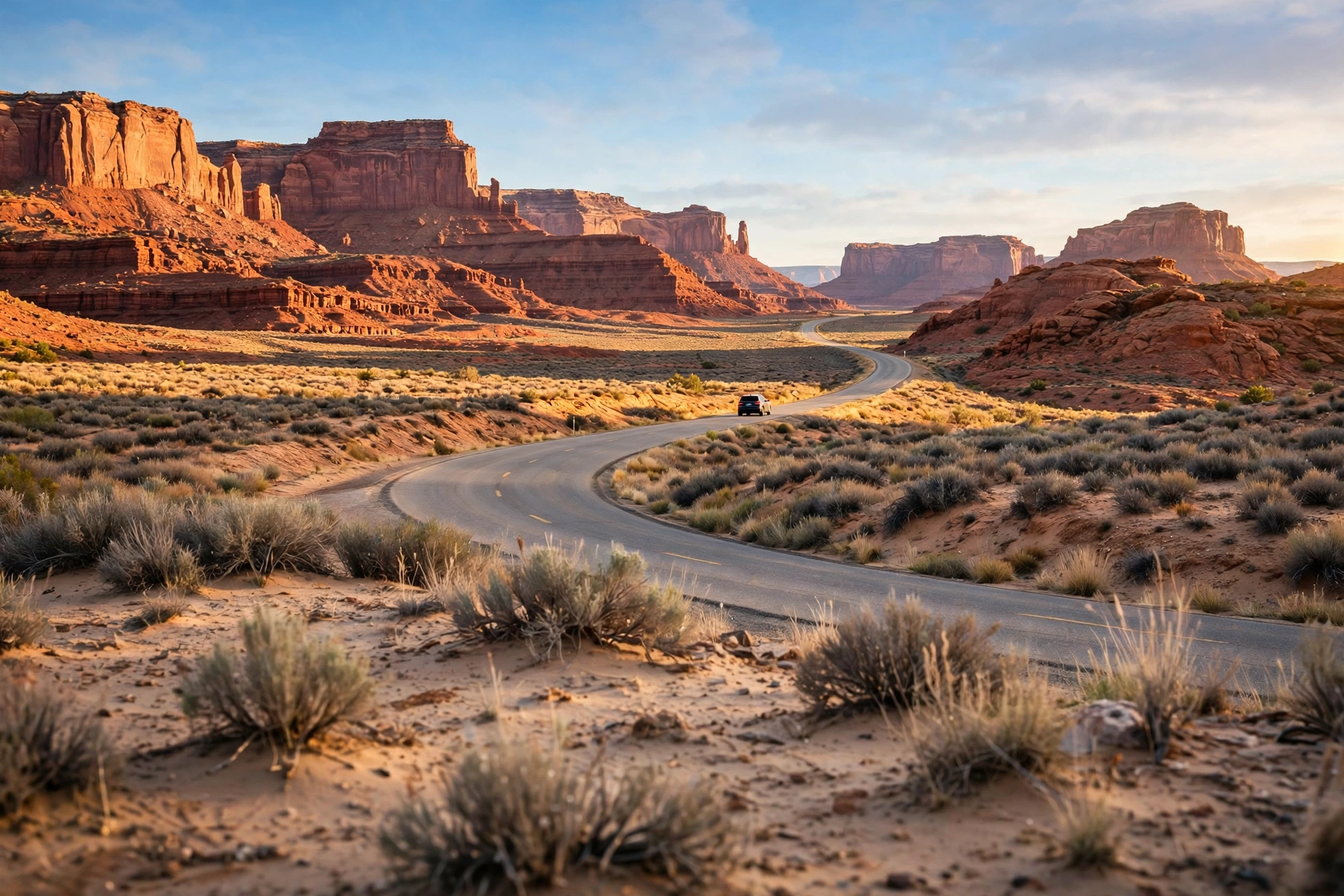
You are driving west out of the last town before the desert opens up, and suddenly there is nothing but red rock, wide sky, and a road running straight toward the horizon. The radio fades, the air smells faintly of dust and juniper, and a mesa appears where you expected empty land. That feeling is why you drive the American Southwest rather than fly over it: the landscape changes constantly, and the best moments usually happen between the famous viewpoints, not at them.
What Counts as the American Southwest?
For this guide, the Southwest means Arizona, Utah, New Mexico, and southern Nevada and Colorado. Each route below works as a self-contained trip, and you can join them together: the Utah loop and the Grand Canyon route meet around Monument Valley and northern Arizona.
Desert driving differs from city driving: fuel stations can be far apart, mobile signal comes and goes, and summer heat at low elevations is serious. The preparation section near the end covers those points.
1. Utah’s Mighty 5 Loop: The Classic Southwest Road Trip
If you only drive one Southwest route, make it this one. Starting from Las Vegas, the loop runs through Zion, Bryce Canyon, Capitol Reef, Arches, and Canyonlands — Utah’s five national parks — and back through Monument Valley and the Grand Canyon. Allow at least seven days; ten is more comfortable, because each park deserves a full day.
Zion comes first, about a two-and-a-half-hour drive from Las Vegas, where canyon walls rise above the Virgin River and the park shuttle carries you between trailheads. Bryce Canyon, roughly 85 miles further on, is a complete contrast: a high amphitheatre of orange hoodoos best seen at sunrise. From Bryce, scenic UT-12 crosses open plateaus to Capitol Reef, a quieter park many drivers rush past and later regret missing.
Moab is the base for the last two parks. Arches holds a dense collection of natural stone arches, including Delicate Arch, while Canyonlands next door is wilder and emptier, with vast overlooks above the Colorado River. To plan the Utah leg in more detail, read our guide to places to visit in Utah from Las Vegas before you fix your overnight stops.
From Moab, head south to Monument Valley, where great buttes stand alone on the desert floor, then west to the Grand Canyon’s South Rim to finish the loop. Book park lodges and gateway-town hotels well ahead in spring and autumn, when demand is highest.
2. Grand Canyon, Sedona, and Arizona’s Red Rocks
This shorter route suits a long weekend or a first taste of Arizona. Start at the Grand Canyon’s South Rim, open all year, with the classic viewpoints, the Rim Trail, and the main visitor services. Spend a full day there: the canyon changes colour through the day, and sunset followed by a quiet early-morning rim walk shows you two different places.
Then drive south to Sedona, set among red rock buttes and pine forest, made for short hikes and scenic drives like the Red Rock Scenic Byway. The historic mining town of Jerome, above the Verde Valley, makes an easy half-day detour toward Phoenix or Flagstaff.
3. Route 66 Through Arizona: A Slower Kind of Road Trip
Route 66 is not the fastest way across Arizona, and that is exactly why people still drive it. The Arizona stretch runs through Flagstaff, Williams, Seligman, and Kingman, much of it still on the old two-lane road rather than the interstate. What you get is small-town America at driving pace: neon signs, classic diners, vintage motels, and roadside attractions kept alive by drivers who keep stopping.
Seligman is the heart of the Arizona section, a town that kept its Route 66 character when the interstate bypassed it, and Williams pairs the old road with a working railway town and the gateway to the Grand Canyon’s South Rim. Give this route a full day, and treat the stops as the destination: the pleasure here is the rhythm of short hops, frequent stops, and small-town encounters.
4. New Mexico’s High Desert: Santa Fe, Taos, and White Sands
New Mexico feels different from Arizona and Utah, and that difference is worth a trip of its own. Start in Santa Fe, where adobe buildings, art galleries, and a compact historic plaza make for easy walking. The food is a draw in its own right: New Mexican cuisine, built around green and red chile, is distinct from Tex-Mex, and asking for “Christmas” means both red and green chile.
From Santa Fe, the Enchanted Circle is a roughly 85-mile loop through Taos, Red River, and Questa, climbing into pine forest and alpine valleys that surprise drivers who expect only desert. Taos Pueblo, a multi-storey adobe community inhabited for centuries, sits just outside the town of Taos; visit respectfully, follow local guidance on photography, and remember you are visiting people’s homes, not a museum set.
With an extra two days, drive south to White Sands, where waves of white gypsum sand stretch to the horizon. It is a long drive from Santa Fe, so treat it as an extension, not a day trip, and plan fuel and water stops carefully.
When to Go: Seasons Change Everything in the Desert
Spring and autumn are the most comfortable seasons for Southwest road trips. Daytime temperatures are warm but manageable, high parks are usually free of winter closures, and autumn brings quieter viewpoints after the summer peak.
Summer is possible but demanding. Low desert areas around Phoenix and Las Vegas can be dangerously hot, so hike early, carry far more water than you think you need, and never leave children or pets in a parked car. Winter flips the problem: the South Rim and Utah’s high parks can be cold and icy, and some high roads close. If you are weighing an autumn departure, our guide to the best places to visit in November in the USA can help you judge what the quieter season looks like.
Practical Tips Before You Set Off
Choose a car with reliable air-conditioning, and check the spare tyre before you leave the rental lot. Fill up whenever the tank drops below half on rural stretches, since the next station can be further than the map suggests. Download offline maps for your whole route, as signal disappears in canyons.
Water is the one thing you cannot improvise. Carry at least a gallon per person per day in the car, plus more for hiking, and drink before you feel thirsty. Sunscreen, a hat, and sturdy shoes matter on every stop: desert ground is uneven, and a viewpoint walk can turn into a longer trail without warning. For opening times, road closures, and current conditions, check the National Park Service pages for each park before you go, since fees and shuttle rules change between seasons.
Finally, respect the land you drive through. Much of the Southwest is tribal land, national park, or protected desert: stay on marked roads and trails, and leave gates as you find them. If part of your trip is a solo drive, read our solo travel safety tips for first time travelers for the basics on staying reachable and sharing your route.
FAQ: Road Trips in the American Southwest
How many days do I need for a Southwest road trip?
Grand Canyon and Sedona work in three to four days. The Utah Mighty 5 loop needs at least seven days, and ten is better. Fitting all four routes here into one week means too much driving and too little time anywhere.
Do I need a four-wheel-drive vehicle?
No, for the routes in this guide. A standard car handles the paved highways and park roads. Four-wheel drive only matters for unpaved backcountry roads, which need separate research and a check of current conditions.
Is the Southwest safe for a first-time road trip?
Yes, with basic desert preparation: a reliable car, fuel and water discipline, offline maps, and realistic daily distances. The main risks are heat, dehydration, and fatigue, all of which good planning prevents.
Final Thoughts
The best road trips in the American Southwest reward slowness. Pick one route, give it the days it deserves, and let the drive itself be the experience: the long light on the mesas, the small towns between the parks, and the quiet stretches where the road is yours alone. Plan the practical details, then leave room for the stop you did not expect.