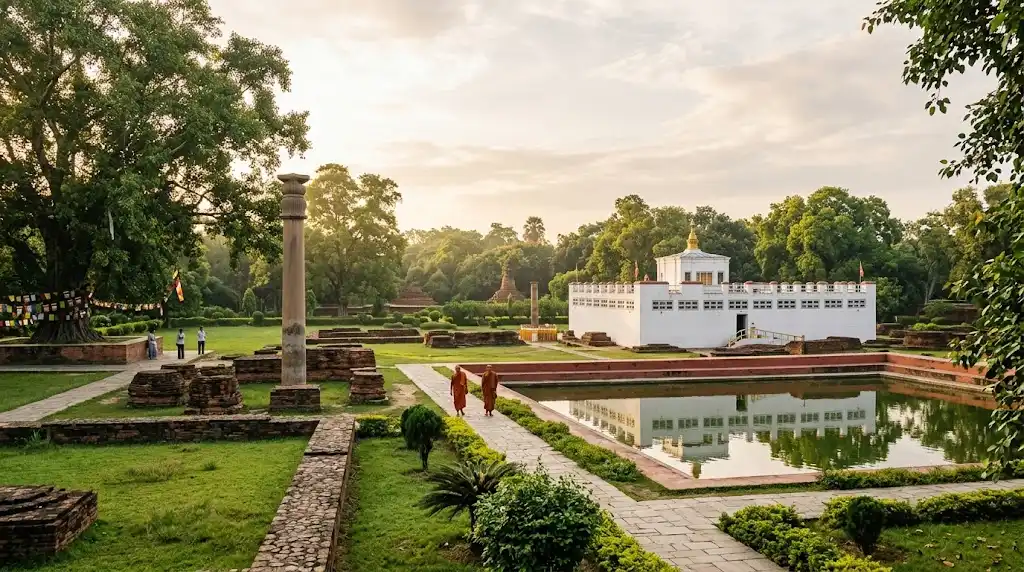
The best places to visit in Lumbini Nepal include the Maya Devi Temple, Ashoka Pillar, Sacred Garden, Puskarini Pond, World Peace Pagoda, Lumbini Museum, International Monastic Zone, and several important archaeological sites in the wider Greater Lumbini area.
Whether you are visiting as a Buddhist pilgrim, history enthusiast, photographer, or traveler interested in South Asian heritage, Lumbini offers an experience that can be explored at a relaxed pace.
1. Maya Devi Temple
Maya Devi Temple is the central attraction in Lumbini and the most important place to begin your visit. The temple marks the sacred location traditionally associated with the birth of Siddhartha Gautama.
Archaeological excavations inside the complex have revealed layers of structures from different periods. The temple complex contains the Marker Stone and Nativity Sculpture, while the surrounding area preserves archaeological remains associated with early Buddhist pilgrimage.
Visitors should allow enough time to explore the temple respectfully rather than treating it as a quick sightseeing stop. Its religious significance makes it especially important to observe local rules and maintain a quiet atmosphere.
2. Sacred Garden
The Sacred Garden forms the spiritual heart of the Lumbini Master Plan. It surrounds the Maya Devi Temple and contains several of the site’s most important religious and archaeological landmarks.
Among its major features are the Maya Devi Temple, Ashoka Pillar, Marker Stone, Nativity Sculpture, Sacred Pond, ancient monasteries, and structural remains. The Lumbini Development Trust describes the Sacred Garden as the central zone of the master plan.
The garden is also a good place to slow down, walk between monuments, and appreciate the landscape surrounding the sacred archaeological area.
3. Ashoka Pillar
The Ashoka Pillar is one of Lumbini’s most significant historical monuments. The pillar was erected by Mauryan Emperor Ashoka during his pilgrimage to Lumbini in the 3rd century BC.
Its inscription provides important historical evidence identifying Lumbini with the birthplace of the Buddha. UNESCO specifically recognizes the pillar and its inscription as evidence of Lumbini’s outstanding religious and archaeological importance.
The pillar stands within the Sacred Garden close to the Maya Devi Temple, making it easy to include both landmarks in the same visit.
4. Marker Stone
The Marker Stone is located within the Maya Devi Temple complex and identifies the spot traditionally associated with the Buddha’s birth. It was uncovered during archaeological excavations of the temple area.
For pilgrims, the Marker Stone is among the most meaningful features of Lumbini. For history and archaeology enthusiasts, it also provides an opportunity to understand how archaeological investigation has contributed to the interpretation and preservation of the site.
Puskarini Pond, also known as the Sacred Pond, is located near the Maya Devi Temple. It forms part of the historic landscape surrounding the birthplace site.
The pond is an important component of the Sacred Garden and is often visited together with the Maya Devi Temple, Ashoka Pillar, and other monuments in the central archaeological zone.
6. Nativity Sculpture
The Nativity Sculpture is another important archaeological object associated with the Maya Devi Temple complex. It depicts the traditional birth scene of Prince Siddhartha and provides visitors with additional context about Lumbini’s Buddhist heritage.
The sculpture was discovered during archaeological work and is preserved as part of the site’s collection of significant historical remains. The Lumbini Development Trust identifies it alongside the Marker Stone and Ashoka Pillar as one of the major monuments of the Sacred Garden.
7. International Monastic Zone
The International Monastic Zone is one of the most distinctive parts of modern Lumbini. Buddhist communities and organizations from different countries have established monasteries representing different Buddhist traditions and architectural styles.
Walking through the zone allows visitors to see how Buddhist communities from around the world have contributed to Lumbini’s development as an international pilgrimage center.
The monasteries also make the area particularly interesting for travelers who want to experience the cultural diversity of Buddhism rather than focusing exclusively on the archaeological core.
8. World Peace Pagoda
The World Peace Pagoda, also known as the Peace Pagoda, is one of the recognizable landmarks in the wider Lumbini complex. Its white structure and large dome create a striking contrast with the surrounding greenery.
The pagoda represents a message of peace and provides another place for visitors to experience the spiritual atmosphere of Lumbini. It is located away from the central Maya Devi Temple area, so allow time to travel between the two sections of the complex.
9. Lumbini Museum
The Lumbini Museum is a useful stop for visitors who want additional historical and cultural context. Museum exhibits can help explain the development of Lumbini, Buddhist heritage, archaeology, and the international significance of the pilgrimage site.
Including the museum in your itinerary is especially useful after visiting the archaeological monuments because it can provide broader context for what you have seen throughout the Sacred Garden.
10. Lumbini International Research Institute
The Lumbini International Research Institute is part of the cultural and educational infrastructure associated with Lumbini. It supports research and study related to Buddhism and Buddhist traditions.
While it may be more relevant to researchers and students than casual tourists, its presence demonstrates that Lumbini functions as more than a pilgrimage destination. It is also an international center for Buddhist study and scholarship.
11. Lumbini Crane Sanctuary
The Lumbini Crane Sanctuary adds a nature-focused experience to a trip otherwise dominated by religious and archaeological sites. The area provides wetland habitat and opportunities to observe birds and other elements of the local ecosystem.
The Lumbini Development Trust specifically recommends visiting the crane sanctuary and nearby wetlands for nature observation, including opportunities to see the Sarus crane and other biodiversity.
It can be a particularly pleasant addition for visitors who want to balance temple visits with time outdoors.
12. Tilaurakot
Tilaurakot is one of the most important archaeological sites in the wider Lumbini area. It is traditionally identified with ancient Kapilavastu, associated with the early life of Siddhartha Gautama.
The Nepal Tourism Board places Tilaurakot about 27 kilometers west of Lumbini and describes the site as an archaeological location where excavations have uncovered remains associated with the ancient settlement.
Travelers interested in Buddhist history should consider adding Tilaurakot to a longer Lumbini itinerary rather than limiting their visit to the central Sacred Garden.
13. Kudan
Kudan is another archaeological site associated with the life of Buddha. According to the Nepal Tourism Board, Kudan is located south of Tilaurakot and is traditionally associated with an important meeting between Siddhartha Gautama and his father after the Buddha’s enlightenment.
The site is particularly relevant to visitors interested in following the wider Buddhist heritage trail around Lumbini.
14. Ramagrama Stupa
Ramagrama Stupa is a significant Buddhist archaeological site in the wider Lumbini region. The Lumbini Development Trust identifies Ramagrama among the important heritage locations associated with the Greater Lumbini area.
The site can be incorporated into a broader pilgrimage or heritage itinerary for travelers who have more than one day to explore the region.
15. Devadaha
Devadaha is another historically important destination in the Greater Lumbini area. It is associated with the ancient Koliya kingdom and forms part of the wider network of sites connected with the life and history surrounding Siddhartha Gautama.
Visitors interested in going beyond the central Lumbini complex can include Devadaha as part of a broader archaeological and cultural tour of the region.
Best Places to Visit in Lumbini for First-Time Visitors
If this is your first visit, start with the Maya Devi Temple and Sacred Garden. These areas contain the most important monuments associated directly with Lumbini’s religious and archaeological significance.
After exploring the central area, visit several monasteries in the International Monastic Zone and continue to the World Peace Pagoda. If you have additional time, add the Lumbini Museum and Crane Sanctuary.
Best Places in Lumbini for History Lovers
History enthusiasts should spend extra time around the Maya Devi Temple, Ashoka Pillar, Marker Stone, Nativity Sculpture, and archaeological remains. A longer itinerary should also include Tilaurakot, Kudan, and other Greater Lumbini archaeological sites.
UNESCO notes that Lumbini’s archaeological remains include Buddhist monasteries and stupas dating across many centuries, making the site valuable for understanding the development of early Buddhist pilgrimage centers.
Best Places in Lumbini for Nature Lovers
Although Lumbini is best known for its spiritual and archaeological attractions, visitors can also experience gardens, wetlands, rural landscapes, and bird habitats.
The Lumbini Crane Sanctuary and surrounding wetland areas are particularly useful for adding nature to your itinerary. Cycling through rural villages and green fields is another activity recommended by the Lumbini Development Trust.
How Many Days Do You Need in Lumbini?
One full day can cover the principal attractions inside Lumbini, including the Maya Devi Temple, Sacred Garden, Ashoka Pillar, major monasteries, and World Peace Pagoda.
Two days provide more flexibility for visiting the museum, Crane Sanctuary, additional monasteries, and surrounding attractions. Travelers interested in the wider Buddhist archaeological circuit should consider staying longer so that Tilaurakot, Kudan, Ramagrama, Devadaha, and other sites can be explored without rushing.
How to Get Around Lumbini
Lumbini’s attractions are spread across a planned complex containing the Sacred Garden, Monastic Zone, and Cultural Center and New Lumbini Village. The Lumbini Development Trust notes that cycling through the surrounding area is one of the recommended activities.
For visitors covering multiple sections, bicycles and local transportation can make it easier to move between attractions. Nepal Tourism Board states that Lumbini is about 22 kilometers from Bhairahawa, with buses and taxis available from Bhairahawa.
Tips for Visiting Lumbini
- Start with the Sacred Garden: Visit the Maya Devi Temple and principal archaeological monuments early in your itinerary.
- Dress respectfully: Lumbini is an important religious destination, so modest clothing is appropriate around temples and monasteries.
- Allow time for monasteries: The International Monastic Zone contains architecture and traditions from different Buddhist communities.
- Carry water: Outdoor walking and cycling can become tiring, particularly during warmer periods.
- Check current visitor information: The Lumbini Development Trust operates a Visitor Information Centre that provides visitor guidance and information.
- Consider a local guide: A knowledgeable guide can make the archaeological and religious history easier to understand.
- Plan the wider circuit separately: Sites such as Tilaurakot and Ramagrama require additional travel beyond the central Lumbini complex.
More Travel Inspiration
If you are planning a broader international trip, explore our guide to the places to visit near Kuala Lumpur Airport for another Southeast Asian destination.
You can also explore places to visit in Penang at night, the best places to visit in South Korea, and the best places to visit in the Philippines.
For travelers interested in seasonal Asian destinations, our guides to places to visit in Korea during winter and the best places to visit in northeast Thailand offer additional ideas.
Final Thoughts
The best places to visit in Lumbini Nepal extend well beyond the famous Maya Devi Temple. The Sacred Garden, Ashoka Pillar, Marker Stone, Puskarini Pond, international monasteries, World Peace Pagoda, museum, and Crane Sanctuary offer different perspectives on Lumbini’s religious, historical, cultural, and natural importance.
For a deeper experience, expand your journey beyond the central complex to Tilaurakot, Kudan, Ramagrama, and other archaeological sites in the Greater Lumbini area. Whether you are visiting for pilgrimage, history, culture, or peaceful surroundings, Lumbini provides an opportunity to explore one of Nepal’s most significant heritage destinations at a thoughtful pace.