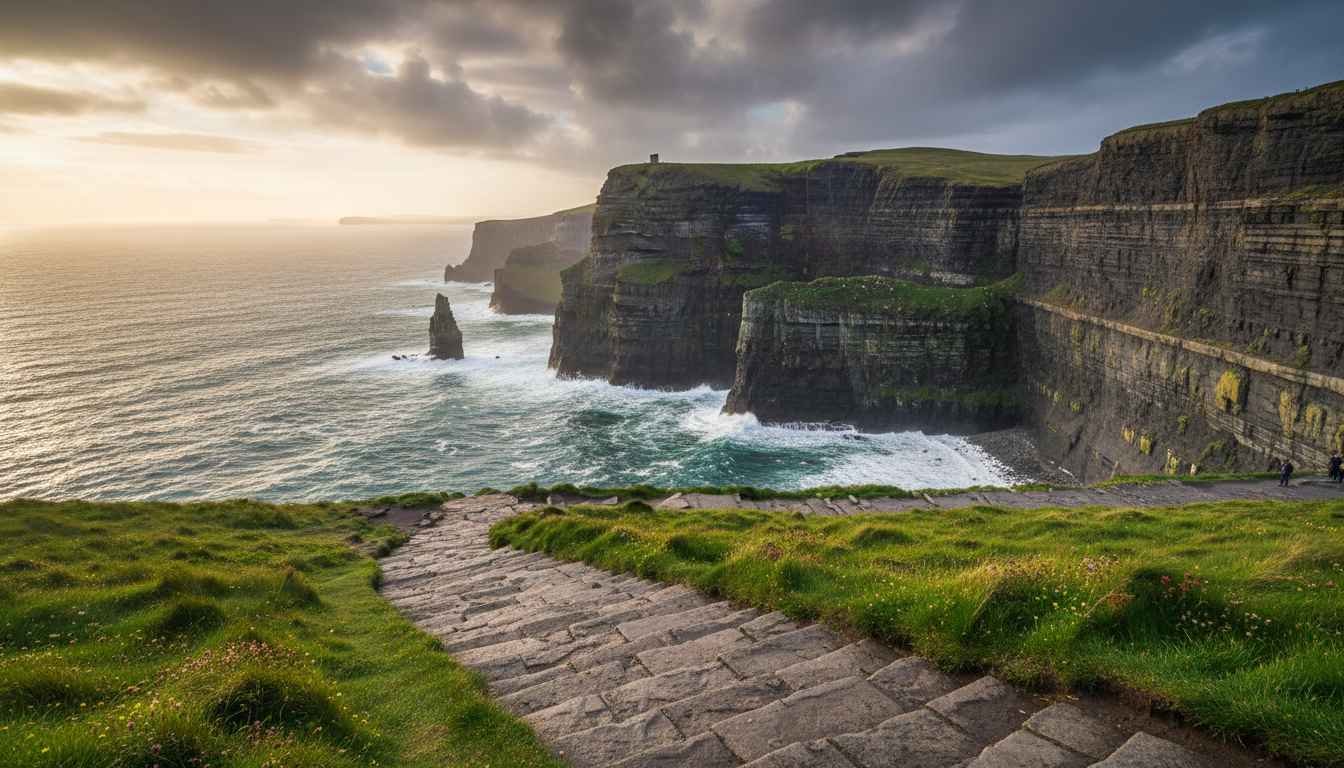
Picture yourself standing at the edge of the Cliffs of Moher as the Atlantic wind pulls at your jacket and seabirds wheel below you over a sea that shifts from slate grey to deep teal. Then, the same afternoon, you are in a warm Galway pub listening to a fiddle session while rain taps the window. That is Ireland in a nutshell: dramatic landscapes, deep history, and a warmth that has nothing to do with the weather.
This guide covers the places to visit in Ireland that genuinely deserve a spot on your itinerary. Each entry below includes what to actually see and do there, so you can plan a trip built around real experiences rather than a checklist of names.
Cliffs of Moher, County Clare
The Cliffs of Moher are the most visited natural attraction in Ireland, and for good reason. The cliffs rise about 214 metres above the Atlantic at their highest point and stretch for roughly eight kilometres along the coast. Walk the cliff path from Doolin to the visitor centre (or just a section of it) for the full drama, and bring a windproof layer no matter the season. On a clear day you can see the Aran Islands and the mountains of Connemara across Galway Bay. Early morning visits are usually the quietest.
Ring of Kerry
The Ring of Kerry is a 179-kilometre circular driving route around the Iveragh Peninsula in the southwest, and it packs an astonishing variety into a single day on the road. Highlights along the way include the Torc Waterfall near Killarney, the colourful towns of Sneem and Kenmare, the Skellig Ring at the western tip, and Rossbeigh Strand’s long sandy beach. Take the route anticlockwise to stay with the flow of the tour buses, and allow time to stop — the viewpoints are the whole point.
Dublin
Ireland’s capital rewards at least two full days. Start at Trinity College to see the Book of Kells and the Old Library’s Long Room, then walk through the grounds to Dublin Castle. The Guinness Storehouse at St. James’s Gate is part museum, part tasting room, and the Gravity Bar at the top offers a panoramic view over the city. For a dose of literary Dublin, stroll Merrion Square and visit the National Gallery, which is free. In the evening, follow the locals to the quieter pubs around St. Stephen’s Green rather than the Temple Bar quarter.
Galway
Galway is Ireland’s cultural heart on the west coast, a compact, walkable city where buskers play on Shop Street and the Spanish Arch looks out over the River Corrib. It is the natural base for day trips to the Aran Islands and Connemara, but the city itself deserves a full day: wander the Latin Quarter, browse the market at St. Nicholas’ Church, and spend an evening in a traditional pub where a music session might simply start up unannounced.
Dingle Peninsula
West of Killarney, the Dingle Peninsula feels like Ireland turned up a notch — wilder, greener, and quieter than the Ring of Kerry. Drive the Slea Head Drive for one of the country’s great coastal roads, with views out to the Blasket Islands. The town of Dingle itself is a gem: brightly painted pubs, fresh seafood, and a harbour that used to be home to Fungie the dolphin. Stop at the Gallarus Oratory, a dry-stone early Christian church, and at Dunbeg Fort, a promontory fort above the cliffs. Fewer tour buses come here, which is exactly the point.
Giant’s Causeway, County Antrim
Crossing into Northern Ireland is worth it for the Giant’s Causeway alone. Around 40,000 interlocking basalt columns — formed by volcanic activity some 60 million years ago — step down into the sea in a formation that genuinely looks unreal. According to legend, the giant Fionn mac Cumhaill built the causeway as a path to Scotland. Walk the cliff-top trail for the best views over the columns. Combine it with the nearby Carrick-a-Rede rope bridge for a full day on the Antrim coast.
Aran Islands
Reached by ferry from Galway or Doolin, the three Aran Islands — Inishmore, Inishmaan, and Inisheer — feel like Ireland as it was a century ago. Irish is the first language here, stone walls divide tiny fields, and the pace is unhurried. On Inishmore, walk or cycle up to Dun Aengus, a prehistoric hill fort whose semicircular stone walls sit right at the edge of a 100-metre cliff drop. Hire a bike at the ferry port; the islands are made for slow exploration. Staying overnight lets you experience the islands after the last ferry leaves.
Killarney and Killarney National Park
Killarney town is the gateway to one of Ireland’s most beautiful national parks. The park covers over 10,000 hectares of lakes, woodland, and mountains, including Torc Waterfall, Muckross House and Gardens, and Ross Castle on the shores of Lough Leane. Take a traditional jaunting car (horse-drawn carriage) ride, walk the lakeshore paths, or drive to Ladies View for a classic panorama over the Upper Lake. For a broader look at the country’s iconic sights, see our roundup of the most famous places to visit in Ireland to compare notes before you finalise your route.
Blarney Castle and Gardens
Blarney Castle, near Cork, is famous for one thing: the Blarney Stone, set in the battlements, which legend says grants the gift of eloquence to anyone who kisses it. Climbing the narrow medieval staircases to lean backwards over the parapet is a rite of passage — and the castle grounds are arguably as good as the stone itself. The gardens include the Poison Garden, a fern garden, and woodland walks along the river. It is an easy half-day trip from Cork city and pairs well with a wander through Cork’s English Market.
Wicklow Mountains and Glendalough
Just south of Dublin, the Wicklow Mountains offer the easiest escape into wild Ireland from the capital. Glendalough — the “valley of the two lakes” — is the centrepiece: a 6th-century monastic settlement founded by St. Kevin, with its round tower, stone churches, and lakeside walks all in one valley. Hike the miners’ road around the Upper Lake for the best views, then drive the scenic Sally Gap through blanket bog and mountain passes. It is the perfect day trip if you want monastic history and mountain scenery without a long drive.
Planning Your Ireland Trip
A week to ten days covers the highlights comfortably: two days in Dublin, a couple of days on the west coast (Galway and the Cliffs of Moher), the Ring of Kerry or Dingle, and a day in Northern Ireland for the Giant’s Causeway if your itinerary allows. Renting a car gives you the most freedom — Ireland’s best scenery is on the small roads — but note that the main sights are all connected by bus and train if you prefer not to drive on the left.
FAQ: Frequently Asked Questions About Visiting Ireland
- How many days do you need in Ireland?
Seven to ten days is a comfortable length for a first trip, covering Dublin, the west coast, and the southwest. Less than five days and you will be rushing; more than two weeks and you can explore the north and southeast properly.
- What is the best way to get around Ireland?
A rental car is the most flexible option, especially for the Ring of Kerry, Dingle, and the Wicklow Mountains. Dublin, Galway, and Cork are well served by train and bus, so a mix of public transport and organised day tours also works.
- Do I need a visa to visit Ireland?
It depends on your nationality. Many visitors, including US, UK, EU, and Canadian citizens, can enter visa-free for short tourist stays. Check the Irish Naturalisation and Immigration Service website for your country before booking.
Final Thoughts
Ireland is not a destination you “do” in a rush. The best moments tend to be unplanned: a detour down a boreen that ends at a hidden cove, a conversation with a farmer over a fence, a rainbow that appears and vanishes in the space of a song. The places above give your trip its backbone — the Cliffs of Moher, the Ring of Kerry, Dublin, Galway, Dingle, the Giant’s Causeway, the Aran Islands, Killarney, Blarney, and Glendalough — but leave room in the schedule for the island to surprise you. That is when Ireland does its best work.