You wake up, reach for your phone, and the day starts before you have even stood up. Your shoulders are tight, your back feels stiff, and your mind is already racing through the to-do list. Now picture a different start: you roll out a mat in a quiet corner of your living room, take a slow breath, and give yourself fifteen calm minutes before the world asks anything of you. That is what a morning yoga routine for beginners at home is really about — not perfect poses, but a gentler way to begin the day.
Why Morning Is the Best Time for Yoga
Morning yoga works because it meets your body where it is. After a night of lying still, your muscles are cool and a little stiff, and gentle movement wakes them up gradually instead of jolting them. Stretching and slow breathing first thing also shake off sleepiness more kindly than a second cup of coffee, and many people feel calmer and more focused for hours afterward.
Research supports the idea, with sensible limits. The U.S. National Center for Complementary and Integrative Health notes that research suggests yoga may help improve general wellness by relieving stress and supporting sleep and balance, and that yoga is generally low-impact and safe for healthy people when practiced appropriately. It is not a cure for anything, but as a daily habit it is one of the simplest ways to look after yourself — see the NCCIH summary of what research says about yoga’s effectiveness and safety.
There is a practical reason too: mornings are the one part of the day you can usually protect. Meetings, errands, and tiredness pile up by evening, but fifteen minutes before breakfast rarely gets stolen by anything else.
What You Need Before You Start
Almost nothing. You need a yoga mat or a folded blanket on a non-slip floor, comfortable clothes you can move in, and a space about the size of a doorway. A glass of water nearby is useful; breakfast can wait until after. Skip the fancy equipment — blocks and straps can help later. If your knees are sensitive, fold a towel under them; if you cannot sit cross-legged comfortably, sit on a cushion.
A Simple 15-Minute Morning Yoga Routine
This routine takes about fifteen minutes and uses gentle poses only. Move slowly, breathe through your nose, and never force a stretch into pain — if a pose feels wrong, skip it and come back to it another day.
1. Easy Seated Breathing (2 minutes)
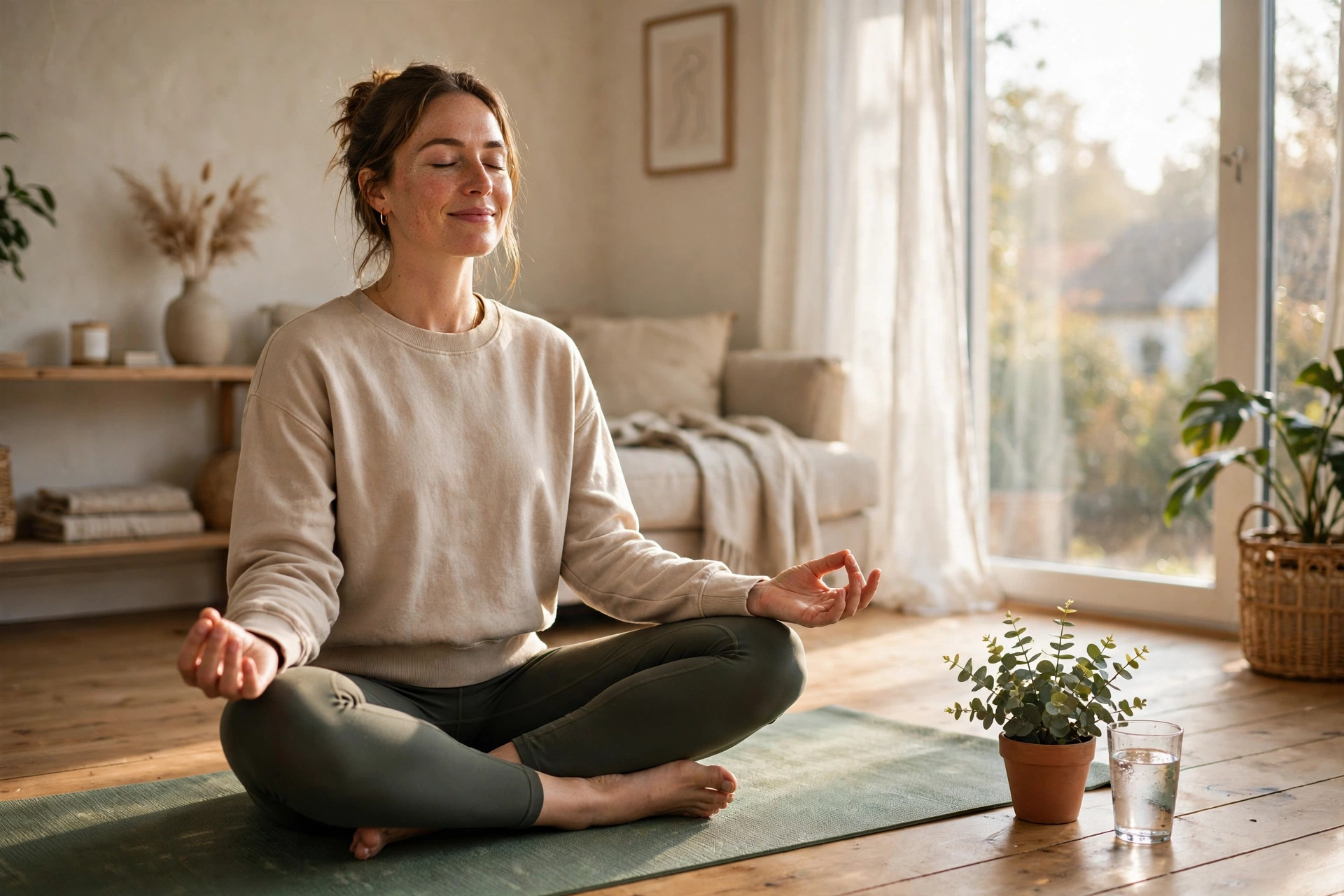
Sit cross-legged or on a cushion, hands resting on your knees. Close your eyes, relax your shoulders away from your ears, and breathe in for four counts and out for six. This settles your breathing and tells your body the day is starting calmly.
2. Neck and Shoulder Rolls (1 minute)
Drop your right ear toward your right shoulder and hold for three breaths, then switch sides. Roll both shoulders forward five times, then backward five times. Most of us carry the night’s stiffness here, so do not rush this step.
3. Cat-Cow (2 minutes)
Come onto all fours, wrists under shoulders and knees under hips. On an inhale, drop your belly and lift your head and tailbone (cow). On an exhale, round your spine and tuck your chin (cat). Repeat slowly for eight breaths — this warms up the whole spine and wakes your back gently.
4. Downward-Facing Dog (1 minute)
From all fours, tuck your toes and lift your hips up and back into an upside-down V. Keep a soft bend in your knees — straight legs are not the goal — and pedal your feet gently, one heel at a time, for five slow breaths.
5. Low Lunge, Each Side (2 minutes)
Step your right foot forward between your hands and lower your left knee to the mat. Hold for five breaths, feeling a gentle stretch through the front of the left hip, then switch sides.
6. Standing Forward Fold (1 minute)
Stand up, feet hip-width apart, and fold forward from the hips, letting your head and arms hang. Bend your knees as much as you need to, sway gently for five breaths, then roll up slowly.
7. Chair Pose and Tree Pose (2 minutes)
From standing, bend your knees and lift your arms overhead as if sitting in an invisible chair — hold for three breaths, then stand tall. Next, shift your weight to one foot and place the other foot on your ankle or calf (never on the knee), hands together at your chest, for three breaths each side. Use a wall for balance if you need it.
8. Seated Twist and Savasana (4 minutes)
Sit with legs stretched out, bend your right knee, and place your right foot outside your left knee. Twist gently to the right for five breaths, then switch sides. Then lie flat on your back, arms at your sides, palms up, and rest completely for two minutes.
How to Breathe During Your Routine
Breathing is half the practice. The simple rule is: inhale as you open or lift, exhale as you fold or twist. Breathe through your nose, keep the breath slow and even, and never hold your breath to get deeper into a pose — if you are panting or clenching your jaw, ease off.
5 Beginner Mistakes to Avoid
- Copying the picture, not your body. Flexibility looks different on every body. A shallow stretch with a calm breath beats a deep stretch done with strain.
- Skipping the warm-up. Cold muscles in the morning are easy to strain. The seated breathing and cat-cow at the start are not optional extras — they are the warm-up.
- Holding your breath. It is the clearest sign you are pushing too hard. Back out until you can breathe normally again.
- Practicing on a full stomach. Wait at least an hour after a big meal — a light routine on an empty stomach, with water first, usually feels best.
- Quitting after one awkward session. Everyone feels clumsy at first. The routine gets easier after about two weeks of regular practice.
How to Make It a Daily Habit
Start small and attach the routine to something you already do: lay your mat out the night before, and practice right after brushing your teeth or before you check your phone.
Think of your morning routine as one part of a healthier day, not a standalone fix. Pairing your yoga with a daily walk, like the 10,000-step habit for beginners, gives you two gentle movement habits that reinforce each other. And a steady morning routine can even support your nights — if restless nights are a problem, our guide on how to sleep better without medication covers simple, drug-free steps that work well alongside morning yoga.
Track your streak on a calendar — a simple row of crosses is surprisingly motivating — and if you miss a day, just start again the next morning.
Frequently Asked Questions
How long should a morning yoga routine be for a beginner?
Fifteen minutes is a good length: long enough to warm up, stretch, and breathe properly, and short enough to fit before work or school. If it feels like too much at first, do the first five minutes only and build up over two or three weeks.
Can I do morning yoga on an empty stomach?
Yes — most beginners prefer it. A glass of water first is enough; if you feel light-headed, eat something small like a banana ten minutes before you start.
Is morning yoga safe if I have back pain?
Gentle yoga may help some people with low-back pain, but it is not a treatment and it is not right for everyone. Move slowly, skip anything that causes sharp pain, and talk to your doctor or a qualified instructor first if you have a back injury, a medical condition, or you are pregnant.
Do I need to be flexible to start yoga?
No. Flexibility is something yoga develops — it is not a requirement. The poses in this routine work at whatever range of movement you have today.
Final Thoughts
A morning yoga routine for beginners at home does not need to be impressive. It needs to be yours: fifteen quiet minutes, a few gentle poses, and a breath that slows down before the day speeds up. Start tomorrow morning with just the seated breathing and cat-cow if the full routine feels like too much. In a few weeks, you may find those fifteen minutes are the part of the day you protect most.