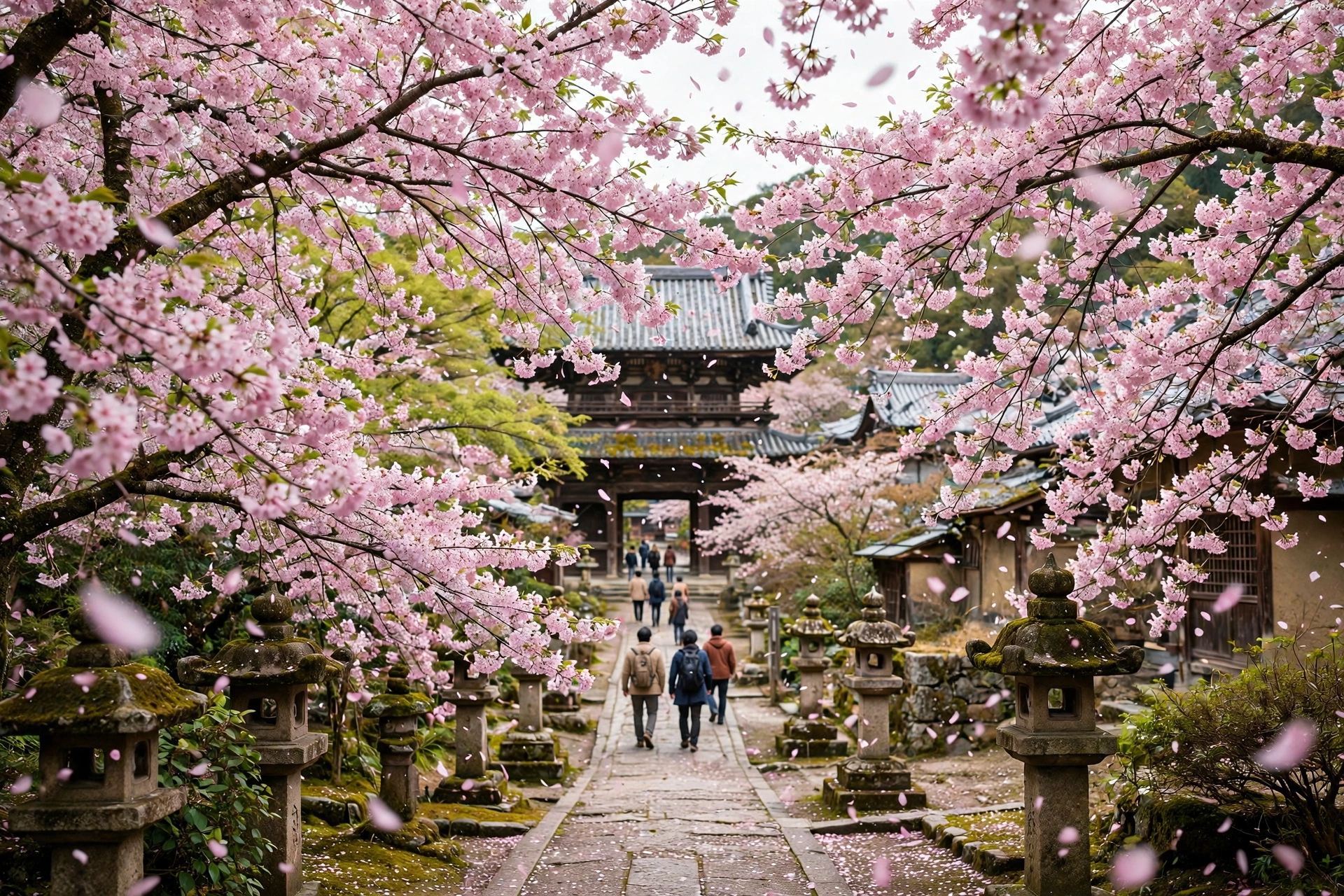
You are standing under a canopy of pale pink blossoms as petals drift onto a quiet temple path, and for a few days each spring, that scene is everywhere in Japan. The catch is timing. Cherry blossoms do not bloom across the whole country at once, and full bloom in any one city usually lasts only about a week. This guide explains when to go, how the bloom moves from south to north, and how to plan a trip that gives you the best chance of seeing sakura at its peak.
The Short Answer: Late March to Early April for Most First-Time Visitors
If you are planning a classic first trip built around Tokyo, Kyoto and Osaka, aim for late March to early April. That is the typical window when those cities reach full bloom, though the exact dates shift from year to year with winter and early-spring temperatures. A trip of 10 to 14 days in that window gives you more flexibility than a short weekend: if one city peaks a few days early or late, another city on your route may still be in full colour.
Do not treat a single date as a promise. Forecasts are estimates, and wind or rain can shorten peak colour, while a cool spell can delay it. Build a little slack into your plan, and check the latest local forecast as your departure approaches.
How the Bloom Moves Across Japan
The cherry blossom front, known as sakura zensen, moves broadly from south to north over roughly six weeks. Warm southern regions bloom first, and colder northern regions bloom last. That is why a traveller who misses Tokyo can sometimes still catch the bloom farther north, and why booking Hokkaido for late March would be a mistake.
Typical windows, by region:
- Okinawa and the far south: January to February, for early-blooming varieties.
- Kyushu (including Fukuoka): mid to late March.
- Tokyo, Kyoto and Osaka: late March to early April.
- Central Honshu mountain towns such as Kanazawa and Takayama: early to mid-April.
- Tohoku (including Sendai): mid to late April.
- Hokkaido (including Sapporo): late April to early May.
Use these as planning windows, not fixed appointments. The Japan Meteorological Corporation and the Japan Weather Association publish updated forecasts in the months before the season, and those updates become more reliable as spring approaches.
When to Go, by Travel Style
For a first visit: late March to early April, centred on Tokyo and Kyoto. You get the most famous viewing spots, the fullest range of spring events, and the easiest transport connections.
For photography: arrive a few days before expected full bloom. Trees are already photogenic, crowds are slightly thinner, and you still catch the peak if it arrives a little early. Staying through full bloom gives you both the build-up and the falling-petal stage, which many photographers love.
For fewer crowds: choose a later-blooming region, or a smaller town rather than the most famous park in Kyoto. Mid-April in Tohoku and late April in Hokkaido can feel calmer than peak week in the big cities, and the blossoms are just as real there. Spring timing rewards careful date-checking in other destinations too, as shown by our guide to the best places to visit in the Midwest in spring.
For a lower budget: avoid the exact peak weekend in Tokyo and Kyoto if you can. Prices for flights and hotels in those cities climb around peak bloom, and the best rooms sell out months ahead. Travelling just before the peak, or heading to a later-blooming region, can ease both cost and crowding.
Beyond the Famous Parks
Tokyo and Kyoto deserve their reputations, but they are not the only places to enjoy hanami, the custom of viewing blossoms. Riverside paths, castle grounds and neighbourhood parks across Japan offer the same pink canopy without the same crush. In Kyoto, quieter temple gardens can be more rewarding than the single most photographed street. In smaller cities, a castle park at full bloom can feel like a local festival rather than a tourist queue.
If your dates are fixed and the big cities have already peaked, look north. A train ride to a later-blooming region is often the simplest rescue plan for a blossom trip, and it turns a missed peak into a second chance rather than a disappointment.
Booking and Planning Tips
Book flights and hotels early. Peak-bloom accommodation in Tokyo and Kyoto sells out months before the flowering date is confirmed, because demand follows the calendar rather than the forecast. By the time precise bloom dates are known, a few weeks out, the best rooms are often gone. For the flight side of that early booking, see how to find cheap international flights from the USA.
Keep your itinerary flexible where it matters. Choose hotels with reasonable cancellation terms where possible, avoid packing every day with fixed tickets, and leave at least one unplanned day you can spend wherever the blossoms look best that week.
Pack for changeable spring weather. A light waterproof jacket, layers for cool mornings and warm afternoons, and comfortable walking shoes matter more than a heavy coat. Blossom viewing involves a lot of walking, and spring showers are common.
Hanami Etiquette Worth Knowing
Hanami is a shared, often joyful occasion, and a few courtesies go a long way. Do not shake branches or pick blossoms, keep picnic areas tidy and take your rubbish with you, and keep noise down in temple grounds and residential neighbourhoods. In busy parks, follow posted signs about where picnics are allowed and where walking paths must stay clear. A little restraint keeps the experience pleasant for everyone, including the people who live beside the park.
FAQ:
How long does full bloom last?
In any one place, full bloom usually lasts about a week, though wind and rain can shorten it. That is why a longer trip, or a route covering more than one region, improves your odds.
What is the best month for cherry blossoms in Japan?
For Tokyo, Kyoto and Osaka, late March into early April is the usual answer. Across the whole country, the season stretches from January in Okinawa to early May in Hokkaido, so the best month depends on where you are going.
Should I book before the forecast is out?
Yes, for peak-season hotels in Tokyo and Kyoto. Book early on flexible terms, then use updated forecasts to fine-tune day trips and the order of your stops.
What if I miss peak bloom in Tokyo?
Head north. Later-blooming regions such as Tohoku and Hokkaido, or higher-altitude towns in central Japan, may still be in bloom, and a flexible rail itinerary makes that switch practical.
Final Thoughts
The best time to visit Japan for cherry blossom season is not a single date on a calendar. It is a window matched to your route: late March to early April for Tokyo, Kyoto and Osaka, later in April for central and northern Japan, and early May at the northern edge. Book early, keep one or two days flexible, check the forecast as spring approaches, and let the bloom — not a rigid itinerary — decide where your best blossom day happens.