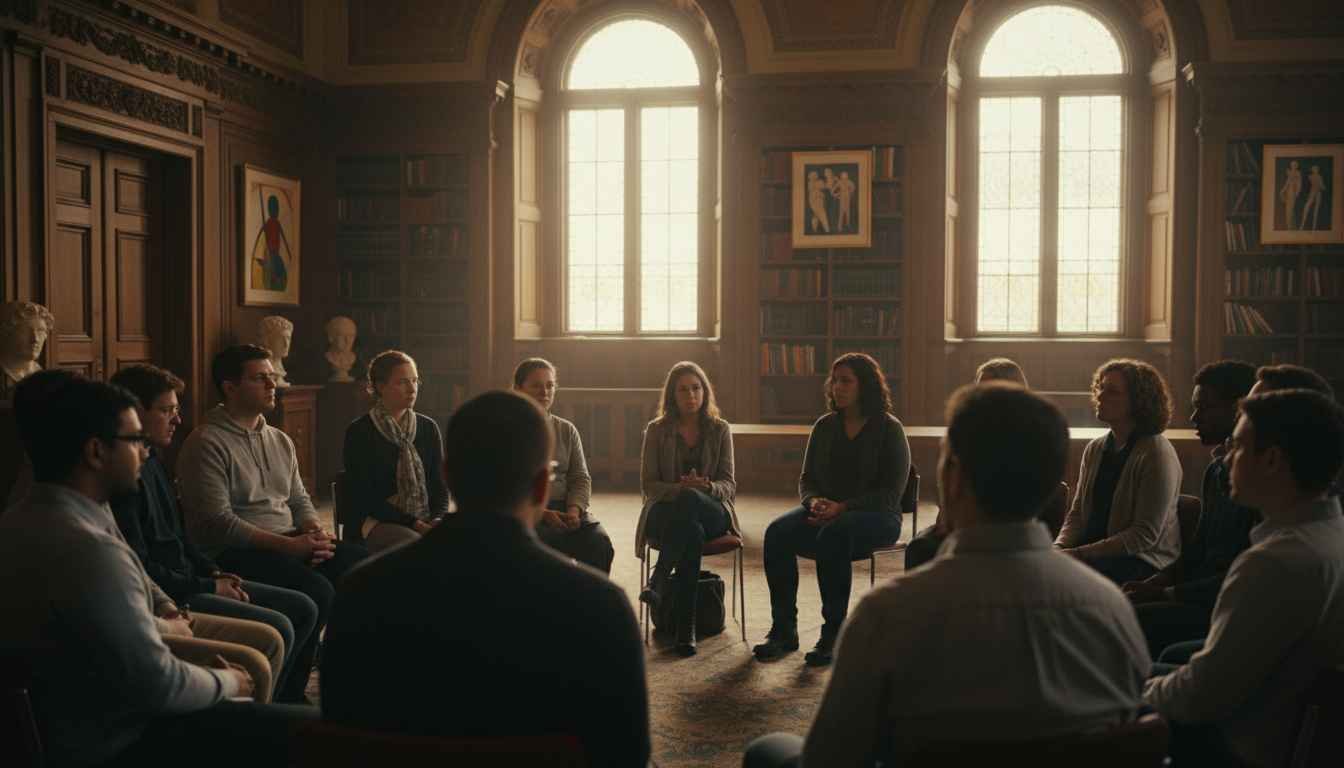
Picture yourself walking into a room in Manhattan where nobody is trying to sell you anything, convert you to anything, or entertain you for an hour. People are there to talk seriously about how to live well and treat others fairly — and to admit, honestly, how hard that can be. That tension, between wanting the world to be better and living with the world as it is, sits at the heart of the Society for Ethical Culture New York.
The old song lyric in this article’s title — you can’t always get what you want — turns out to be a fair summary of the Society’s outlook. It does not promise easy answers or instant transformation. It offers something slower and, for the right person, more useful: a community built around ethics, reason, and service, without religious doctrine.
What the Society for Ethical Culture New York Actually Is
The Society for Ethical Culture New York was founded in 1876 by Felix Adler, and it grew into the first society of the Ethical Culture movement in the United States. Its basic idea was radical for its time and still distinctive today: people can build a moral life and a caring community on shared human values — honesty, compassion, fairness, and responsibility — rather than on a shared creed.
In practice, that means the Society functions as an ethical and humanist community. Sunday meetings typically combine music, reflection, and a talk on a moral or social question, followed by discussion. It also runs youth ethics education, giving children a place to think about kindness, fairness, and decision-making without religious instruction. Community service and social justice work have long been part of its identity, from education initiatives to civic engagement in New York City.
It is worth being clear about what it is not. It is not a church, synagogue, or mosque, and it does not ask members to profess a particular faith. People of varied beliefs — and of none — take part, united by the ethical project rather than by theology. If you are looking for worship in a traditional sense, this is not that. If you are looking for a place to think carefully about right and wrong with other people, it may be exactly that.
What Its Programs Look Like in Real Life
Public lectures and talks are the most visible part of the Society’s work. Topics tend to be grounded in everyday moral life and public questions: how to raise children ethically, how to act responsibly at work, how communities should treat their most vulnerable members, and how to respond to injustice without losing your humanity in the process.
Youth programs focus on age-appropriate ethical thinking rather than rules handed down from above. Children discuss real dilemmas — sharing, fairness, standing up for a classmate — and learn to explain their reasoning. For parents who want moral education outside a religious framework, this is one of the Society’s most distinctive offerings.
Community service and social action give the ideas somewhere to go. Ethical reflection that never leaves the meeting room can drift into abstraction, and the Society’s history suggests it knows this. Getting involved in a service project or a civic initiative is where members test whether their values survive contact with real logistics, real disagreements, and real people.
The Honest Drawbacks Nobody Should Skip
The Society’s reflective style is also its main limitation. Meetings are discussion-heavy and deliberately unhurried. If you want high-energy entertainment, a polished performance, or a quick emotional lift, a thoughtful lecture on moral responsibility may feel slow — and no amount of good intentions changes that.
Idealism also meets practical limits here, as it does everywhere. A community committed to social justice still has to deal with budgets, volunteer burnout, and the gap between what it believes and what it can actually change. Visitors sometimes notice a gap between lofty language and modest results. That gap is not necessarily a failure — small communities rarely remake a city — but it is worth seeing clearly before you invest your time.
There is also a subtler risk: ethical talk can become a performance. Any community built around values can slip into congratulating itself for holding the right views while doing very little differently. The test, as with any group, is not what it says on a Sunday but how its members behave on a Monday — at work, at home, and in disagreements.
Who It Suits — and Who It Probably Won’t
The Society tends to suit people who enjoy thinking things through: readers, teachers, civic-minded New Yorkers, parents seeking secular moral education for their children, and anyone who wants a community without a creed. It rewards patience, curiosity, and a willingness to be challenged rather than simply affirmed.
It is less likely to suit people who want a faith community, a social club with a busy events calendar, or a fast route to professional networking. New York has plenty of those, and they do them better. The Society’s strength is narrower and quieter: serious conversation about how to live, in a city that rarely slows down long enough for it.
For a sense of how mission-driven groups in the city actually operate day to day, it helps to understand the world of internships at New York City nonprofits, where idealism meets schedules, supervision, and real workloads. And if you are curious about how such organisations divide their work, a look at how nonprofit organizations structure their teams shows why even value-driven groups need clear roles to get anything done.
How to Approach It Thoughtfully
If you are curious, start as a visitor rather than a joiner. Attend a public program, listen more than you speak at first, and notice whether the discussion feels honest or merely polite. Ask practical questions: what service projects are currently active, what does youth education actually involve, and how are newcomers welcomed into real participation rather than just attendance?
Pay attention to how disagreement is handled. A community that only agrees with itself is not doing ethics; it is doing comfort. The healthier sign is respectful disagreement — people changing their minds in public, or at least taking an opposing view seriously.
Finally, judge it by its fruits in your own life. Does attending make you kinder, fairer, or more useful to the people around you? If it does, the slow pace is a feature, not a flaw. If it doesn’t, no amount of beautiful language about ethics should keep you there.
Final Thoughts
The Society for Ethical Culture New York will not give you everything you want. It will not hand you certainty, instant community, or a simple answer to a hard question. What it offers is rarer in a city built on speed: a room where people take ethics seriously, admit their own shortcomings, and try — imperfectly, week after week — to live a little better. For some people, that is precisely the point. For others, it will feel like a slow dance in a disco. Knowing which one you are is the first ethical decision the Society asks you to make.
FAQ
Is the Society for Ethical Culture a religion?
Not in the traditional sense. It is an ethical and humanist community: it focuses on shared moral values and conduct rather than on doctrine, scripture, or worship of a deity, and it welcomes people of varied beliefs.
Do you have to be a philosopher to fit in?
No. The discussions can be thoughtful, but they are grounded in everyday life — parenting, work, fairness, and community responsibility — rather than academic philosophy.
What should a first-time visitor expect?
Expect a calm, discussion-based gathering: music and reflection, a talk on an ethical or social topic, and conversation afterwards. It is participatory, but nobody expects a newcomer to have all the answers.