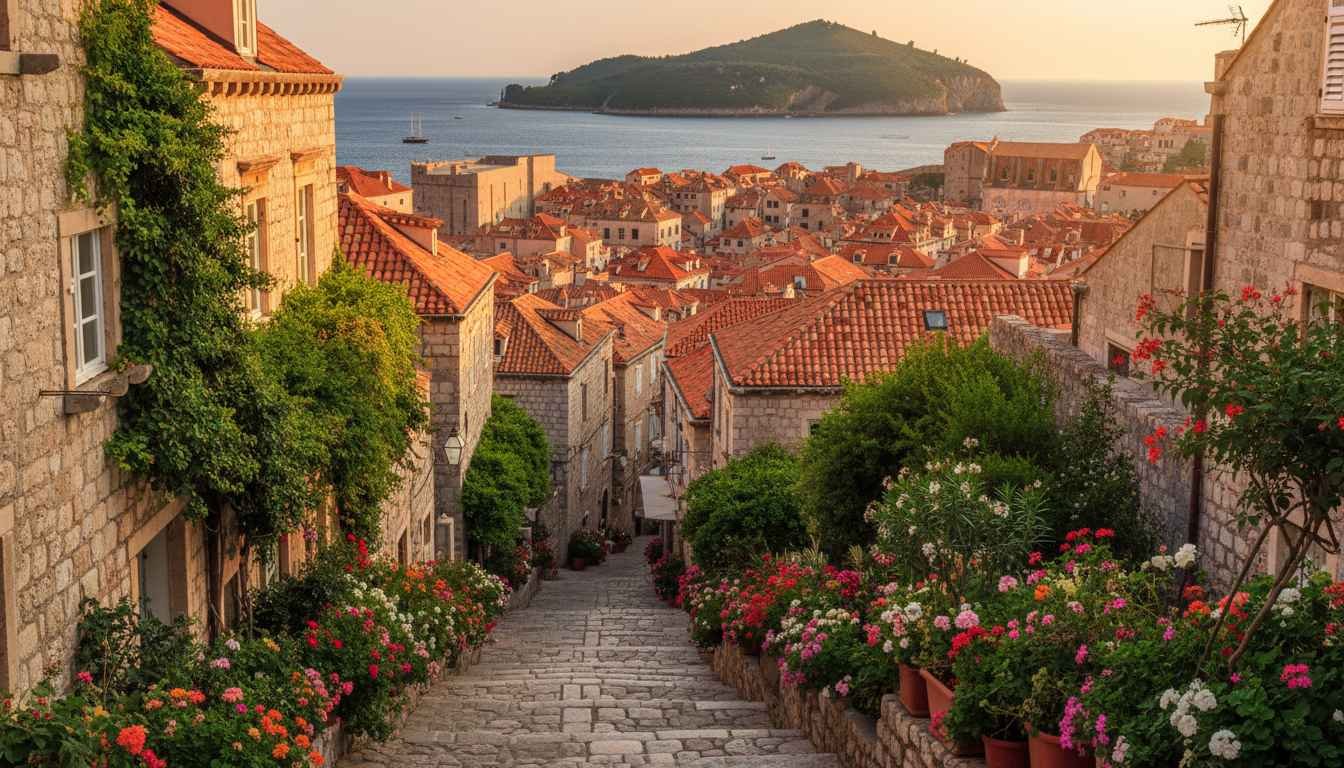
Picture this: you are standing on top of a centuries-old stone wall as the sun drops toward the sea, terracotta rooftops glowing below you and sailboats drifting across a blue so clear it hardly looks real. That is Croatia on an ordinary evening. Tucked between the Adriatic Sea and the mountains of the Balkans, this country packs walled medieval cities, Roman palaces, island-hopping coastlines, and some of Europe’s most beautiful waterfalls into a land area smaller than West Virginia. The best places to visit in Croatia are spread between the coast and the interior, so the perfect trip usually mixes both.
1. Dubrovnik: The Pearl of the Adriatic
Few cities in the world announce themselves the way Dubrovnik does. Its massive limestone walls, built between the 12th and 17th centuries, wrap completely around the Old Town, and walking the roughly two-kilometer circuit is the single essential experience here. You will pass forts, towers, and staircases with sweeping views over the red rooftops on one side and the open Adriatic on the other. Below the walls, the marble-paved Stradun street runs through the heart of the old city, lined with the Rector’s Palace, the Franciscan Monastery, and Onofrio’s Fountain. Dubrovnik has been a UNESCO World Heritage site since 1979, and it rewards at least two full days.
2. Split and Diocletian’s Palace
Split is the rare city where the ancient world is not behind glass but part of daily life. Its center is Diocletian’s Palace, a retirement residence built for the Roman emperor around the turn of the 4th century, and the old town grew up inside and around its walls. Today you can sip coffee in the Peristyle, the palace’s original central square, then step through the Golden Gate into ordinary streets where laundry hangs from windows of 1,700-year-old buildings. Beyond the history, Split’s Riva waterfront promenade and the beaches of Bačvice make it an easy place to settle into the Dalmatian pace of life.
3. Plitvice Lakes National Park
Inland from the coast lies the place that converts even determined city travelers. Plitvice Lakes National Park is a chain of sixteen terraced lakes connected by hundreds of waterfalls, all set in dense beech and fir forest. Wooden boardwalks carry you right across the water, so close to the falls that you feel the spray. The mineral-rich water shifts between shades of turquoise, green, and blue depending on the light. As Croatia’s oldest and largest national park and a UNESCO World Heritage site, it draws big crowds in summer, so arrive early in the morning or visit in the shoulder months of May and September for a calmer experience. Plan for a full day and wear proper walking shoes; the trail system rewards those who go beyond the first viewpoint.
4. Hvar: Sun, Lavender, and Island Nights
Hvar is Croatia’s most glamorous island, and it earns the reputation. Hvar Town centers on one of the largest squares in Dalmatia, overlooked by a hilltop fortress with panoramic harbor views. Climb up in the late afternoon, when the light softens and the crowds thin. Inland, the island grows quieter: lavender fields bloom in early summer, olive groves and vineyards cover the slopes, and the ancient Stari Grad Plain, a UNESCO-listed agricultural landscape laid out by Greek settlers in the 4th century BC, is still farmed much as it was two millennia ago. Just offshore, the Pakleni Islands offer small coves and pine-fringed beaches reachable by short boat rides. If you love pairing history with island scenery, Rhodes in Greece is another Mediterranean island where medieval streets and ancient ruins share the shoreline.
5. Korčula: A Medieval Town on the Water
Korčula Town sits on a small peninsula like a stone ship at anchor, its herringbone street plan designed centuries ago to catch the sea breeze while blocking harsh winds. Walk the walls, visit the 15th-century St. Mark’s Cathedral, and climb its bell tower for views across the Pelješac Channel. Local tradition claims the explorer Marco Polo was born here, and the town keeps a house associated with the story. The surrounding island is known for its white wines, particularly Pošip and Grk, and small family-run wineries welcome visitors for tastings. Korčula is quieter and more traditional than Hvar, which is exactly its charm.
6. Brač and Zlatni Rat Beach
A short ferry ride from Split brings you to Brač, the largest island in Dalmatia. Its headline attraction is Zlatni Rat, the Golden Horn: a long spit of smooth white pebbles that juts into the sea near the town of Bol and famously shifts shape with the wind and currents. The island is also the source of the luminous white stone used in Diocletian’s Palace and, according to tradition, buildings far beyond Croatia.
7. Zadar: Roman Ruins and Modern Art by the Sea
Zadar is where Croatia’s layers of history meet genuinely inventive modern design. The old town holds a Roman forum, the circular 9th-century Church of St. Donatus, and Venetian walls. Then, at the tip of the peninsula, the waterfront becomes an art installation: the Sea Organ, a set of steps with underwater pipes that play music as the waves move through them, and right beside it the Monument to the Sun, a glass disc that stores daylight and glows after dark.
8. Rovinj and the Istrian Peninsula
Northern Croatia feels like a different country, and Istria is its green, truffle-scented heart. Rovinj is the peninsula’s jewel: a former island, now joined to the mainland, where pastel Venetian-era houses climb a hill topped by the Church of St. Euphemia. Its narrow lanes are full of galleries and wine bars. Inland Istria rolls out hilltop villages like Motovun, olive groves producing some of the world’s most decorated olive oils, and a food culture built around truffles, wild asparagus, and Malvasia wine. It is an easy add-on if you are arriving overland from Italy or Slovenia.
9. Zagreb: The Capital Most Travelers Skip (Don’t)
Most itineraries rush straight to the coast, but Zagreb rewards a day or two. The capital divides into the medieval Upper Town, with its gas-lit lanes, St. Mark’s Square and its tiled roof, and the 19th-century Lower Town with grand squares and the green horseshoe of parks. Zagreb shows you the continental, Central European side of Croatia that the beach brochures leave out.
10. Krka National Park
If Plitvice is the famous waterfall park, Krka is its warmer, more relaxed sibling near Šibenik. The Krka River drops through a series of cascades, the grandest being Skradinski Buk, a wide semicircular fall framed by travertine pools. Unlike Plitvice, swimming was historically permitted in designated areas near the falls, so check current park rules before you go. The park also includes the small island monastery of Visovac, set alone in the middle of the river, and boat excursions connect the main entrances.
When to Visit and How to Plan
Late spring (May to June) and early autumn (September to early October) are the sweet spots for most travelers: warm seas, open restaurants, and thinner crowds than the July–August peak. If you are building a wider trip, Croatia pairs well with neighboring Slovenia, Bosnia and Herzegovina, Montenegro, or northern Italy, and it sits comfortably inside a broader tour of the best places to visit in Europe. For those timing a summer getaway, it also helps to compare notes with other summer international destinations before locking in dates. Ferries connect the mainland with the major islands from spring through autumn; in winter, schedules shrink, so plan island-hopping for the warmer months.
FAQ
- How many days do you need for Croatia?
Seven to ten days covers the highlights comfortably: two days in Dubrovnik, two in Split with a day trip, one full day at Plitvice, and two to three days island-hopping around Hvar, Korčula, or Brač. Add extra days for Istria or Zagreb if you have them. - Is Croatia expensive to visit?
Croatia sits in the middle range for European travel. It is generally more affordable than Italy or France but pricier than the Balkans further east. Accommodation and restaurant prices peak in July and August and drop noticeably in the shoulder seasons. - Do you need a car in Croatia?
Not necessarily. Buses connect the main coastal cities, and ferries serve the islands. A car helps for Plitvice, Krka, and exploring inland Istria at your own pace, but the classic coastal route works well on public transport.
Final Thoughts
Croatia works because it refuses to be one thing. You can walk a Roman emperor’s palace in the morning, swim off a pebble beach in the afternoon, and eat truffle pasta in a hilltop village by evening. Start with Dubrovnik and Split, add at least one national park, and give yourself a few unhurried island days in between. The country rewards travelers who mix the famous sights with slower detours, and it is one Adriatic coastline you will find yourself planning to revisit before you have even left.